


Why Andrew Symes and OXCCU Are Getting Attention in Climate Tech
Aviation has one of the hardest decarbonisation problems in the world. Airlines are under pressure to cut emissions, but the path forward is anything but simple. Electric planes are still limited for long-haul travel, hydrogen remains a longer-term play, and traditional offsets do not solve the core fuel challenge. That is exactly why sustainable aviation fuel has become such an important part of the conversation.
In that race, Andrew Symes and OXCCU have started to stand out.
OXCCU is not trying to build just another climate startup with a nice story and a distant promise. The company is focused on something much more practical: turning waste carbon into sustainable aviation fuel in a way that has a real shot at becoming more affordable. That affordability angle matters. The aviation industry does not just need cleaner fuel. It needs cleaner fuel that airlines and commercial partners can actually buy at scale.
That is where Andrew Symes’ leadership has helped shape the company’s identity. He is not simply attached to the business as a founder figure. He has become one of the central voices behind OXCCU’s effort to move from breakthrough science into commercial relevance. In a sector where many ideas stay trapped in pilot mode, that makes a big difference.
The OXCCU Story Began With Oxford Science and a Commercial Vision
OXCCU’s roots are deeply tied to Oxford innovation. The company emerged as a University of Oxford spinout, built on scientific research aimed at converting carbon dioxide and hydrogen into valuable products such as fuels, chemicals, and other hydrocarbons.
That origin story matters because it explains why OXCCU has earned attention so quickly. It did not begin as a trend-driven business trying to retrofit itself into the climate economy. It started with hard science, and then built a business around the idea that carbon could be treated not just as a problem to remove, but as a resource to use.
That shift in thinking is one of the most interesting parts of the company’s rise. Instead of framing carbon only as waste, OXCCU’s model is built around carbon conversion and fuel synthesis. For a market looking for credible low-carbon fuel pathways, that gives the company a strong narrative and a practical commercial angle.
The leap from university research to a real company is rarely easy. It takes more than a promising lab result. It takes timing, conviction, funding, and the ability to turn a scientific breakthrough into something the market can understand. That is one reason the OXCCU story has become a notable one in climate tech and clean aviation technology.
Andrew Symes’ Role in Turning Technical Innovation Into a Business
A lot of deep tech companies have brilliant science behind them, but not all of them know how to build momentum beyond the lab. That is where Andrew Symes has played such an important role at OXCCU.
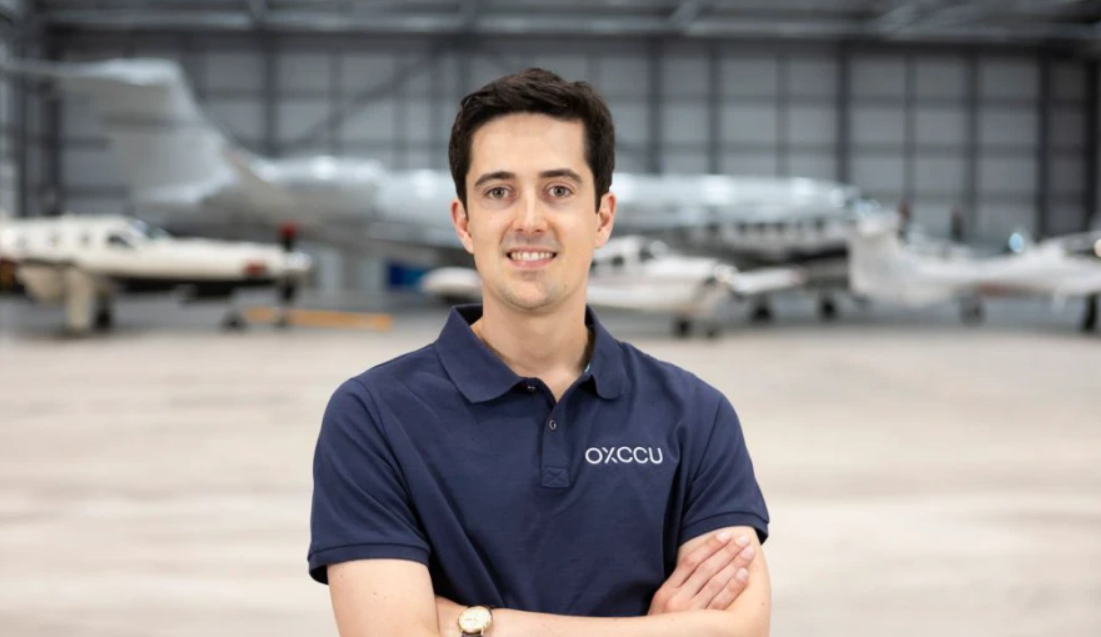
As co-founder and CEO, he has helped position the company as both a scientific innovator and a serious commercial contender. That involves far more than talking about technology. It means building investor trust, communicating a clear market need, attracting strategic partners, and keeping the company focused on the part of the problem that matters most: making SAF production more commercially viable.
What makes Symes’ leadership story compelling is that it sits at the intersection of credibility and ambition. OXCCU is operating in a field where the stakes are high, timelines are long, and the economics are under constant scrutiny. In that environment, leadership needs to be steady, persuasive, and grounded in execution.
Symes has helped do exactly that. Under his leadership, OXCCU has continued to grow its visibility in the sustainable fuel space, raise major funding, and move closer to industrial deployment. That kind of progress is what turns a promising startup into a company people start watching seriously.
What Makes OXCCU Different in the Sustainable Aviation Fuel Market
The sustainable aviation fuel market is getting busier, but not every company is taking the same route. Some SAF pathways involve complicated production chains, multiple processing steps, or higher input costs that make large-scale adoption harder.
OXCCU’s pitch is different. The company has focused on a one-step process designed to convert waste CO2 and green hydrogen directly into longer-chain hydrocarbons. In plain terms, that matters because simpler processes often create a better chance of reducing cost, improving efficiency, and making scale-up more realistic.
That is a major reason OXCCU has found a strong position in the market conversation. It is not only selling a cleaner-fuel vision. It is pushing the idea that cost-effective SAF is possible if the production pathway itself is rethought.
This matters enormously for aviation. Airlines may be eager to reduce their carbon footprint, but they also operate in an intensely cost-sensitive environment. If sustainable aviation fuel remains too expensive, adoption slows down. If it becomes more affordable, the market opens up much faster.
That is why OXCCU’s value proposition has attracted attention well beyond the startup world. It connects directly to one of the biggest unanswered questions in aviation decarbonisation: not just how to make cleaner fuel, but how to make cleaner fuel that can compete.
The OX1 Plant Marked a Major Step From Concept to Proof
Every climate startup reaches a point where the story has to move beyond potential. For OXCCU, one of the clearest moments in that transition came with the launch of OX1, its demonstration plant at Oxford Airport.
This was not just a branding milestone. It was a proof point.
Demonstration plants matter because they show that a company’s process can operate outside a research setting. They make the technology feel more real to investors, partners, and industrial buyers. They also show that the team is serious about the long road from prototype to commercial infrastructure.
For Andrew Symes and OXCCU, OX1 gave the company something every deep tech business needs: visible execution. It showed that the startup was not only talking about sustainable fuel innovation in theory. It was building something tangible.
That is often where confidence starts to grow around a company. It is one thing to present a scientific model. It is another thing entirely to point to a real facility and say the transition is already underway.
Funding Momentum Helped Push OXCCU Into a Bigger League
In climate tech, funding is not just about survival. It is often a public signal of belief.
OXCCU’s Series B funding round became one of the strongest indicators yet that the company’s story was gaining real traction. The round gave the business more than capital. It gave it credibility in a market where investors have become much more selective.
That matters because deep tech investors are not usually backing ideas on enthusiasm alone. They look for technical strength, market need, team quality, and signs that a company can scale. For OXCCU, raising significant growth capital suggested that serious backers saw a real opportunity in its carbon-to-fuel technology.
For Andrew Symes, that milestone also reinforced his position as a leader capable of guiding a complex business through the kind of scale-up phase that defeats many startups. Moving from early-stage promise into funded momentum is a major achievement in itself, especially in a sector where development cycles are long and capital demands are high.
Why Affordability Is the Real Battleground in Sustainable Aviation Fuel
There is a reason the word “affordable” matters so much in any serious conversation about sustainable aviation fuel.
The aviation industry has made it clear that SAF is one of the most realistic near-term tools for cutting emissions from existing aircraft fleets. But there is a catch. In many cases, sustainable fuel still comes at a price premium that makes widespread adoption difficult.
That is where OXCCU’s rise becomes especially relevant.
The company is not trying to win attention purely on environmental language. It is targeting the economic barrier that has held much of the SAF sector back. That makes its mission sharper and more commercially grounded than a lot of climate messaging in the market.
If OXCCU can help narrow the cost gap between conventional jet fuel and lower-carbon alternatives, it will not just be another interesting startup. It will be solving one of the biggest practical problems in green aviation.
That is also why Andrew Symes’ role matters here. His leadership story is tied not only to innovation, but to the discipline of pursuing a market outcome that actually matters. In this case, that outcome is clear: low-cost SAF production that can move beyond niche use and become part of mainstream aviation fuel strategy.
Andrew Symes and OXCCU’s Broader Impact on Aviation Decarbonisation
The rise of OXCCU sits inside a much bigger industry shift.
Airlines, airports, investors, regulators, and fuel suppliers are all under pressure to support net zero aviation goals. Yet every part of that transition comes with trade-offs. Cost, infrastructure, feedstock availability, policy support, and production scale all remain major questions.
That is why companies like OXCCU matter beyond their own growth story. They represent a category of climate business that is trying to solve a hard industrial problem with a commercially usable answer.
OXCCU’s focus on waste carbon to jet fuel gives it a strong place in this wider shift. It suggests a future where decarbonisation is not just about cutting back, but about building smarter production systems. For a sector often criticised for being slow to change, that kind of innovation brings a more practical sense of movement.
Andrew Symes has helped shape that story by keeping OXCCU positioned as both a technology company and an industry participant. The company is not merely discussing the future of aviation. It is trying to help build it.
The Challenges Still Ahead for OXCCU
Even the most promising climate companies face hard questions once they begin scaling.
For OXCCU, the next chapter will be about proving that its technology can move from demonstration to broader industrial deployment without losing the cost and efficiency advantages that make it attractive in the first place. That is never a simple jump.
There are still challenges around infrastructure, commercial partnerships, production capacity, regulation, and long-term economics. The SAF market is growing, but it is also competitive, policy-sensitive, and technically demanding. Every company in the sector has to show that it can survive beyond the excitement of early milestones.
That does not weaken OXCCU’s story. In fact, it makes it more credible. Real success in climate tech is never built on hype alone. It is built on repeated proof, patient execution, and the ability to keep moving through the difficult middle stage between invention and scale.
What Andrew Symes and OXCCU’s Progress Says About the Future of Clean Fuel Innovation
The story of Andrew Symes and OXCCU works because it brings together several forces that increasingly define modern climate success stories: university research, commercial ambition, industrial relevance, and a clear response to market pain points.
Plenty of startups talk about changing the world. Far fewer take on a challenge as difficult as aviation fuel and then build real momentum around making it cleaner and more affordable.
That is what makes OXCCU worth watching.
Its rise reflects more than a strong company narrative. It reflects the growing demand for climate solutions that can work in the real economy. And in a world where sustainable aviation fuel still needs a stronger cost story, Andrew Symes and OXCCU have positioned themselves in one of the most important races in clean technology.