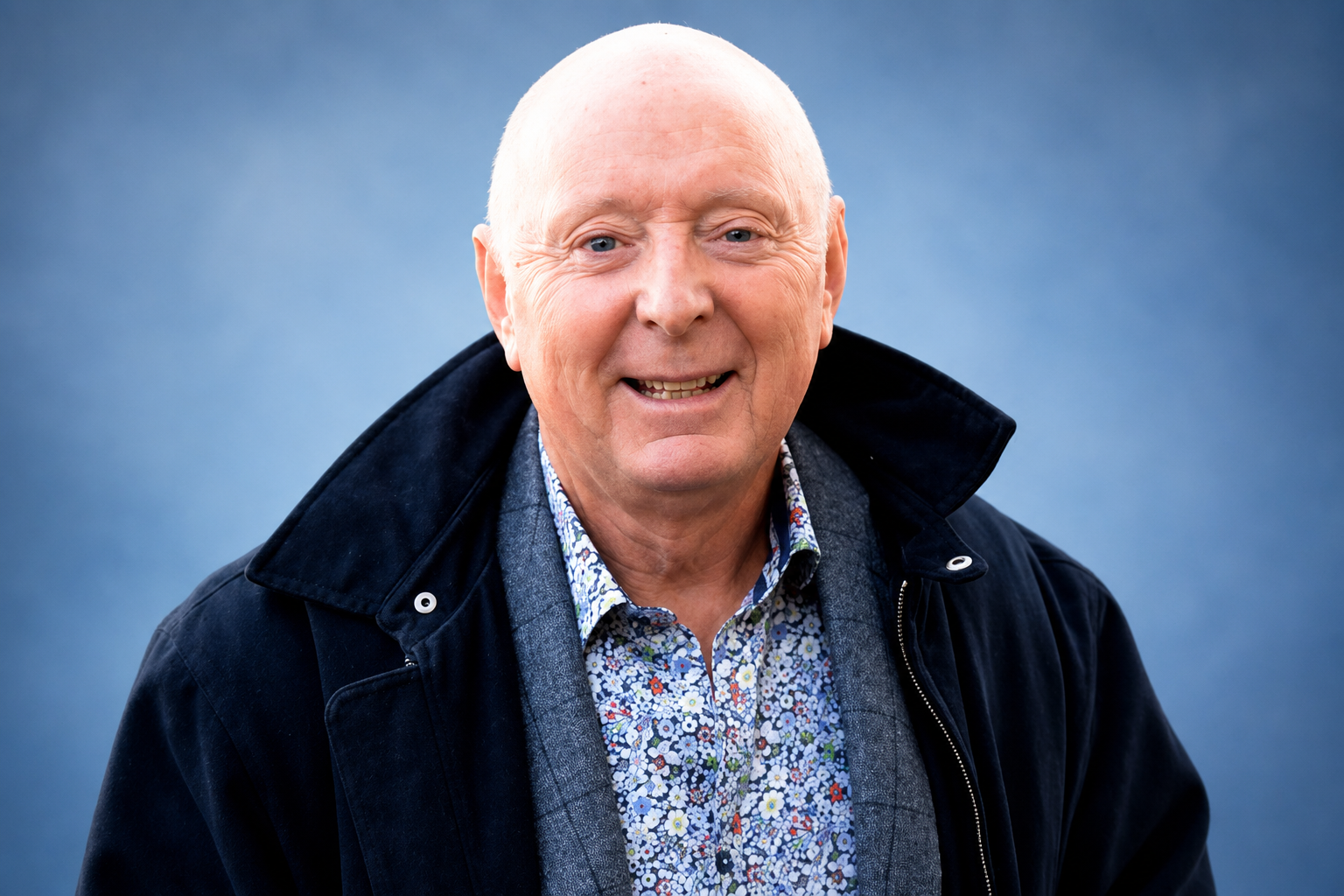
Every net-worth site will tell you Jasper Carrott is worth around $50 million. What none of them explain is the part that makes it a genuinely Birmingham story: the vast majority of that fortune has almost nothing to do with stand-up comedy. It came from a shrewd business decision made in a Solihull production office — a founding stake in the company that created Who Wants to Be a Millionaire?
That’s the wealth story worth telling. A comic from Acocks Green who never moved to London or Los Angeles ended up quietly banking one of the biggest television windfalls in British entertainment history. Here’s how the money actually broke down.
How much is Jasper Carrott’s net worth in 2026?
The figure repeated across the internet is roughly $50 million, which converts to somewhere around £38-40 million depending on the exchange rate. Treat it, as always, as an educated estimate rather than a filed accounts figure — Carrott has never published his net worth, and celebrity wealth totals are reverse-engineered from known deals, property and reported payouts.
What matters more than the round number is where it sits. A working comedian who has toured for fifty years, sold comedy albums and fronted BBC sitcoms would still be comfortably wealthy — but not $50-million wealthy. The gap between “successful comic” money and Carrott’s actual fortune is one deal, and it’s the deal every aggregator page glosses over.
- Real name: Robert “Bob” Norman Davis
- Born: 14 March 1945, Acocks Green, Birmingham
- Estimated net worth: ~$50 million (approx. £38-40m)
- Primary wealth source: Founding stake in Celador Productions
- Home turf: Knowle, Solihull, West Midlands
The Celador story: how a Birmingham comedian helped build Who Wants to Be a Millionaire
In the 1980s, Carrott went into business with television producer Paul Smith, and the company that grew out of that partnership became Celador. Carrott was a founding shareholder, reportedly holding around 15% — a serious slice for a company that was, at the time, just another independent producer making light entertainment.
Then, in 1998, Celador launched Who Wants to Be a Millionaire? It is not an exaggeration to call it one of the most successful television formats ever devised. The show was licensed to more than 100 countries, each paying to run its own version with the same set, the same lighting, the same dramatic music and the same lifelines. A format that travels like that doesn’t just earn — it compounds, year after year, territory after territory.
When Celador sold its production business in the mid-2000s, that value crystallised. Carrott and his wife Hazel reportedly walked away with somewhere in the region of £10 million from the sale — and that’s on top of the dividends a 15% shareholder in a globally licensed hit would have collected across the show’s peak years.
To put it plainly: one commercial decision made in the West Midlands out-earned five decades of telling jokes on stage. That’s not a knock on the comedy — it’s how equity works versus fees.
From Funky Moped to comedy stardom: the early money
Before any of that, there was a moped. Carrott’s national breakthrough came in 1975 with the novelty single “Funky Moped”, which reached the UK Top 5 and gave him the profile — and, crucially, the first proper payday — to buy the family home in Knowle.
From there he built the classic British comedy career: sell-out theatre tours, comedy albums, and a reputation as one of the sharpest observational stand-ups of his generation. Live touring is where a comic’s wealth genuinely scales — you keep a far larger share of a theatre gate than you do of a record royalty — and Carrott worked that circuit for decades. It’s steady, real money. It just isn’t Celador money.
TV career earnings: The Detectives, Canned Carrott and All About Me
Carrott’s television work ran in parallel and added another income pillar entirely. The sketch show Canned Carrott spun off The Detectives, a BBC sitcom with Robert Powell that ran through the 1990s. Later came the sitcom All About Me, alongside presenting and factual work — including series for the National Trust and various one-off specials.
A long-running television career compounds in a way a single hit never does: repeat fees, format credits and the reputational value that keeps the touring diary full. Plenty of well-known faces have built solid fortunes on exactly this kind of steady screen presence — our look at Peter Dinklage’s net worth traces the same fees-and-longevity mechanics from the other side of the Atlantic.
Bob Davis to Jasper Carrott: how the name became a brand
Here’s a detail the biography-wrapper sites mention but never connect to the money. Carrott was born Robert Norman Davis. The “Jasper” was a childhood nickname, picked up during his schooldays in Birmingham, and “Carrott” grew out of it as the stage name stuck.
It sounds like trivia. It isn’t. “Jasper Carrott” is a distinctive, ownable, instantly memorable brand — the kind you can build a touring business, a television career and, ultimately, a production company around. A generic name is forgettable; a name that makes people smile before you’ve said a word is a commercial asset. He was building personal equity long before he built the corporate kind.
Birmingham roots: Solihull, Knowle and staying local
The other thread the national sites miss entirely is that Carrott never left. After “Funky Moped” broke in the mid-1970s, he bought Providence Lodge, the family home in Knowle, and stayed put in the West Midlands rather than decamping to London or Hollywood.
That rootedness is part of the wealth story, not a footnote to it. Staying in Solihull kept his overheads sane and his identity intact — he remained “Birmingham’s Jasper Carrott,” a hometown asset the city still claims, while the Celador money did the heavy lifting in the background. It’s a very un-showbiz approach to being a multi-millionaire, and it’s exactly why the fortune has lasted.
Health, touring and what it means for his fortune in 2026
In recent years Carrott has scaled back. He confirmed via his own social media that he underwent a heart bypass operation, and his live appearances have become far rarer as a result — a meaningful shift for someone whose active income was always driven by touring.
But this is where the Celador structure matters again. When your fortune is banked equity from a global format rather than next month’s ticket sales, reduced touring dents your income, not your wealth. Carrott is, in financial terms, in the enviable position of having already made his money — the live work was the bonus, not the foundation.
How Jasper Carrott’s wealth stacks up against other Brummie names
Against other West Midlands entertainers, Carrott’s fortune is unusual specifically because of its shape. Most comedians and presenters build wealth linearly — fee by fee, tour by tour. Carrott’s came in a step-change from owning a piece of a hit, which is closer to how a tech founder gets rich than how a comic does.
It’s a different route to the same destination as fellow music-and-media veterans whose fortunes rest on catalogue and royalties rather than a single equity payout — see our breakdowns of Rick Wakeman’s net worth and Roger Daltrey’s net worth for how the royalty model compares. Carrott’s story is the outlier: not a performer who got paid a lot, but a performer who owned the thing that paid.
That’s the fact worth remembering the next time you see “Jasper Carrott: $50 million” with no explanation attached. The number is almost beside the point. The story is that a comic from Acocks Green quietly out-negotiated an entire industry — and did it without ever leaving home.
FAQs
What is Jasper Carrott’s net worth in 2026?
Jasper Carrott’s net worth is estimated at around $50 million (roughly £38-40 million) in 2026. The figure is an estimate rather than a disclosed total, and the bulk of it comes from his founding shareholding in Celador Productions rather than from his comedy career.
Did Jasper Carrott really own a stake in Who Wants to Be a Millionaire?
Yes. Carrott was a founding shareholder in Celador Productions, the company that created and produced Who Wants to Be a Millionaire?, reportedly holding around a 15% stake. The show was licensed to more than 100 countries, making it one of the most lucrative TV formats ever.
How much did Jasper Carrott make when Celador was sold?
When Celador sold its production business in the mid-2000s, Jasper Carrott and his wife Hazel reportedly received in the region of £10 million. That was on top of the dividends his shareholding would have generated during the show’s peak years of global licensing.
What is Jasper Carrott’s real name and why is he called Jasper Carrott?
His real name is Robert ‘Bob’ Norman Davis, born in Acocks Green, Birmingham, in 1945. ‘Jasper’ was a childhood nickname from his schooldays, and ‘Carrott’ grew out of it into the stage name he built his entire career and brand around.
Is Jasper Carrott still performing or touring?
Carrott has largely stepped back from live work in recent years, particularly after undergoing a heart bypass operation that he confirmed publicly. His stage appearances are now rare, though his banked Celador wealth means reduced touring affects his income far more than his overall fortune.
Where does Jasper Carrott live now?
Carrott has remained rooted in the West Midlands rather than moving to London or Los Angeles. He bought the family home, Providence Lodge, in Knowle, Solihull, back in 1976 and is still one of Birmingham’s most identifiable exports.